
Not only is the private sector operating deep borings without study or permission, but even after repeated follow-ups, many government agencies have also failed to obtain licenses according to the law. Due to uncontrolled exploitation, the underground water table is depleting on one hand, while on the other, the risks of land subsidence and eco-environmental disturbance are continuously escalating.
About 7.5 kilometers west of Singha Durbar, the country’s main administrative center, lies the Nagarjun area, the western gateway to the Kathmandu Valley. Located in that area is the office of Nagarjun Municipality. Behind the municipal office, in a land-plotting site, stands a large deep tube well. From there, underground water is extracted for up to 10 hours a day and distributed to local residents. 
Ascending toward Nagarjun from Harisiddhi Chowk, near the municipality office, one encounters another deep tube well that reaches a depth of about 250 meters. This one also pumps groundwater for nearly 12 hours a day. That water is collected in a tank with a capacity of 250,000 liters before being distributed.
Near the Adeshwar Temple, roughly three kilometers from Harisiddhi, there are two additional deep tube wells. Water is extracted from both for 8 to 10 hours daily.
How much water is extracted daily from these deep tube wells operating year-round? How much groundwater remains in that area? If exploitation continues at this pace, how long can the underground water resources sustain it? No one has answers to these questions, nor has any study been conducted.
The reason there are no records showing how much groundwater is drawn from these deep tube wells, or how it affects the water table, is that no permission was sought from the relevant authority. Under current legal provisions, permission must be obtained from the Kathmandu Valley Water Supply Management Board prior to deep boring to monitor the status and usage of underground water resources.
According to the Kathmandu Valley Water Supply Management Board Regulations, 2025, permission must be obtained when extracting and using groundwater from depths exceeding 50 meters in sensitive areas and 60 meters in other areas.
Similarly, the Ministry of Urban Development’s ‘Directive Concerning Issuance of Permits for Extraction and Utilization of Underground Water Sources, 2014’ stipulates that all organizations, excluding individuals constructing dug wells and tube wells for household purposes, must acquire a permit from the board. The directive explicitly notes that consumers who were extracting groundwater from wells or tube wells without a license prior to the directive’s implementation must also obtain a permit, just like new tube wells.
As per the rules, a pumping test must be conducted to obtain permission. A report and recommendation certified by a relevant driller and a hydrogeologist or geologist must be submitted to the board. This process provides crucial information regarding groundwater availability and source conditions, while helping systematically manage water utilization and monitoring.
There are six deep tube wells in the Harisiddhi area of Nagarjun alone. However, permission has not been obtained from the board for any of them. Ravi Prasad Khanal, Chairman of the Harisiddhi Water Supply User Committee, admits that the deep tube wells are unregistered. “It should be registered. The process is underway,” he said.
The trend of operating deep tube wells against the law is not limited to Harisiddhi in Nagarjun. Most of the deep tube wells constructed by government agencies and water supply user committees operating with their support are also unregistered. Even borings constructed through government projects and handed over to user committees remain unregistered.
Permission has not been obtained even for borings dug within government office premises. One such example is a 120-meter-deep tube well located inside the office premises of the Department of Water Supply and Sewerage Management in Panipokhari.
More than 200 deep tube wells constructed while running various water supply projects in the Kathmandu Valley have been handed over to user committees. Kamal Raj Shrestha, Director General of the department, states that over 60,000 households in the valley are benefiting from these deep tube wells.
The borings providing water to so many households have neither registration nor permission from the relevant body. Shrestha, the department’s director general, argues that the requirement to seek permission applies only to the private sector. “That applies to the private sector. We drill and distribute wherever we need it,” he said. “We haven’t taken permission so far. If it is mandatory, we will enter the process.”
Dol Prasad Chapagain, Executive Director of the Kathmandu Valley Water Supply Management Board, states that existing laws apply equally to everyone. According to him, there is no provision to charge fees from the private sector while exempting government bodies, or allowing government bodies to bypass obtaining permission altogether.
“According to the law, all deep tube wells must come under permission. There should be research on whether water is being over-exploited,” he said. “We have already sent letters to the local levels regarding this issue. Whether private or government, the existing law gives no one immunity to run deep boring without permission.”
Uncontrolled exploitation of groundwater
Eight years ago, the board conducted a detailed study on groundwater resources in the Kathmandu Valley. According to the study report, there were already 1,429 deep tube wells in the Valley back in 2018. Board officials estimate that this number has increased significantly over the past eight years. However, because the number of those registering and obtaining permits is minimal, the board lacks exact statistics.
Among the deep borings in the valley, operational permits have been obtained for only 489 in the private sector, 118 belonging to Kathmandu Upatyaka Khanepani Limited (KUKL), and 13 in government offices.
Even back in 2018 (2075 B.S.), as many as 809 deep borings were found to be extracting groundwater without authorization. The Board monitors deep tube wells that raise suspicion, conducting inspections on two or three deep tube wells a month. If found without a permit, a 7-day deadline is given along with a directive to obtain authorization. However, business operators fail to procure permits despite receiving these directives.
A case in point is the deep tube well-constructed in Sita Colony at Sitapaila. For the past two years, 20,000 to 39,000 liters of groundwater have been extracted daily for 125 households there, all without a permit. During an inspection last August, the board directed the colony management to acquire authorization, warning that the boring would otherwise be confiscated. Yet, Pravin Chandra KC, a hydrogeologist at the board, states that they have still not obtained a permit.
According to Pravin Chandra, many hotels and private businesses across the Kathmandu Valley are also operating deep borings without permits. During inspections conducted by the board a few months ago, entities such as Pandhero Hotel and Lemon Tree Hotel in Budhanilkantha, Lotus Club Boutique Hotel in Balaju, and Jalpa Tailoring Services in Tokha were found operating deep tube wells without authorization. Although the board instructed them to acquire permits immediately, none have initiated the process so far.
Hydrogeologist Pravin Chandra notes that when private businesses are caught operating without authorization, efforts are made to bring them into the licensing process. In the case of borings operated by the public sector, letters are issued to local governments and relevant government departments. However, government agencies simply ignore them. “Many government agencies have not complied with the legal process,” Pravin Chandra said. “They are extracting and distributing water without meters, yet they do not even respond when we send letters.”
Why do government agencies fail to comply?
There are numerous government offices that the Kathmandu Valley Water Supply Management Board has repeatedly corresponded with, instructing them to obtain licenses for deep borings. The Department of Water Supply and Sewerage Management alone was sent letters on November 27, 2020, September 14, 2021 and February 12, 2023. The letters requested details of the deep borings operated under the department, as they needed to be brought within the legal framework. However, the department never sent a response to the board.
The board has not written to the department since 2023. Pravin Chandra, a hydrogeologist at the board, explains that after sending repeated letters without receiving any response, they stopped writing and decided to move forward through dialogue instead. “The executive director mentioned advancing the matter through the ministry,” he said.
When asked by NIMJN why they did not respond to the board, Narayan Prasad Acharya, Deputy Director General of the department, expressed disagreement with the requirement to pay a fee to register deep borings constructed for public use. “In the case of projects requiring environmental studies, we do obtain authorization for borings. We are also a government office,” he said. “How relevant is it to levy fees on deep borings meant for the public good? Perhaps the law itself needs to be reformed.”
According to board officials, registering a deep tube well costs 20,000 rupees. Following that, an annual renewal fee of 20,000 rupees must be paid. For all deep tube wells, whether public or private, that have been operating without registration and lack records showing when they were drilled, fees must be paid at the rate of 20,000 rupees per year dating back to 2006.
The board has also repeatedly sent letters to local governments within the Kathmandu Valley regarding ‘permits for extraction and utilization of underground water sources.’ Most recently, on August 19, letters (all secured with NIMJN) were dispatched to 10 municipalities, namely, Nagarjun, Tokha, Chandragiri, Mahalaxmi, Godawari, Changunarayan, Kageshwari Manohara, Gokarneshwar, Budhanilkantha and Tarakeshwar, instructing them that deep tube wells under water user committees must be operated only after procuring a permit. However, board officials state that not a single local government replied to the letters.
Because not only private entities but also federal government bodies and local governments fail to comply with legal procedures, exact statistics on deep tube wells in the valley remain unavailable. The board lacks data on deep tube wells run through user committees and even the respective local governments do not possess such records.
According to Rajendra Rai, an official at the Water Supply Unit of Chandragiri Municipality, there are 130 user committees in the municipality. However, the municipal office lacks data on how many locations have deep borings operated via user committees. Rai shared that although the board asks them to come forward for permits, user committees brush it off, arguing that they are simply supplying drinking water to the public. “We tell them to take out permits and keep records of the water drawn but the committees themselves refuse to comply,” he said.
According to Anusha Sharma, an engineer at Tokha Municipality, there are four deep tube wells in the municipal area. None of them have a permit. However, Sharma states that they are in the process of obtaining authorization.
Pushpa Raj Adhikari, an officer at the Environment and Disaster Management Branch of Mahalaxmi Municipality, says that 12 user committees are distributing drinking water in the municipality. Although these committees register with the municipality and renew annually, they do not go to the board to obtain permits. “They register with the municipality and renew for 2,500 rupees a year. Over at the board, the annual renewal fee is 20,000 rupees,” Adhikari said. “If the board enforced strict compliance, we would also instruct the committees to go to the board immediately. But the board hasn’t been able to do that either. So, things just continue as they are.”
Board unable to enforce the law
Chapter 4 of the Kathmandu Valley Water Supply Management Board Regulations, 2025 sets out provisions regarding permits. According to these provisions, an application must be submitted to the board for a separate permit to drill and extract groundwater within the Kathmandu Valley. The regulations empower the board to restrict groundwater extraction or grant permission to extract water only from specified quantities or depths, taking into consideration water quality, volume, supply management, public health and environmental impacts. However, the board has failed to enforce strict compliance.
Pratap Singh Tater, a groundwater expert, states that the government has been unable to bring those arbitrarily extracting water through deep borings into the legal framework. In his view, the law must apply equally to all, whether public or private entities. “It is wrong that some have to register and pay an annual renewal fee of 20,000 rupees while others are allowed to extract groundwater without registering at all,” he said.
Tater notes that the main concern is not merely the fees but the indiscriminate exploitation of groundwater. “Extracting water randomly from anywhere is depleting underground water sources,” he said. “Because borings are dug close together without identifying the sources, tube wells have already begun drying up. This could trigger another disaster.”
In the Kathmandu Valley, only 13 government agencies have obtained permits for deep borings. These include Kathmandu Metropolitan City, Fisheries Research Division, Department of Food Technology and Quality Control, Nepal Agricultural Research Council, Balaju Industrial District Management Office, Directorate of Animal Health, Nepal Electricity Authority, Chilime Hydropower Company Limited, Patan Industrial Estate, and Balaju Industrial District Management (registered across three locations).
However, the study conducted by the board in 2018 revealed that more than 50 government offices in the valley were operating deep tube wells without permits. The number of deep tube wells operated without authorization through user committees is even higher.
There are legal provisions to penalize any consumer, individual, firm, company, or institution that extracts and utilizes groundwater without a permit. The Water Supply Management Board Act, 2006 states that failure to comply with the act or rules made under it carries a fine of up to 50,000 rupees depending on the gravity of the offense. Nevertheless, Executive Director Dol Prasad admits that the board has been unable to initiate legal action. He points to the massive gap between the demand and supply of drinking water in the Kathmandu Valley as the underlying cause.
According to board data, the valley currently requires 500 million liters of water per day. However, Kathmandu Upatyaka Khanepani Limited (KUKL), combined with the Melamchi project, supplies only 300 million liters per day, a portion of which is further lost to leakage.
“Water supply remains significantly below demand. We have not been able to immediately confiscate borings operated by user committees that extract water for public purposes without permits,” Dol Prasad said. “However, this does not mean that those indiscriminately drilling without permits will escape action.” He added that the indiscriminate drilling and over-extraction of water are deteriorating the Kathmandu Valley’s geo-environment.
Dol Prasad, Executive Director of the Kathmandu Valley Water Supply Management Board, claimed that fines have been imposed in a few instances. He noted that in several other cases, repeated letters and follow-ups have been issued. “The government sector itself needs to be responsible and step forward for registration. It should also share concern for the valley’s geo-environment,” he said. “If government bodies fail to come within the legal framework now, we will move forward with the support of the ministry.”
Experts, however, argue that government agencies are ignoring law enforcement. Bhaskar Khatiwada, President of the Nepal Geological Society, commented that state authorities are turning a blind eye toward government entities. “If extraction continues unchecked, the resource will run dry one day. The inability to bring whoever is exploiting the water under control is a failure of the state,” he said. “The board, which exerts control over the private sector, must hold government bodies to the same standard.”
Uncontrolled exploitation puts geo-environment at risk
Controlled extraction of groundwater is permitted upon obtaining a license from the board. The board classifies areas into three categories based on groundwater availability, water table levels, usage and recharge status in a given location: Safe, Semi-Sensitive and Sensitive. The Kathmandu Valley Water Supply Management Board has maintained records specifying which category each region of Kathmandu falls under based on a study conducted in 2014.
On this basis, the board grants permission to extract water from a single tube well at a rate of 1 to 15 liters per second in safe zones, 2 to 7 liters per second in semi-sensitive zones, and 2 to 3 liters per second in sensitive zones. Meters are installed to monitor the volume of water extracted. During the annual permit renewal, meter inspections are conducted to verify whether extraction has exceeded the prescribed limits. Fines are levied if excess water extraction is detected.
Hydrologist Madhukar Upadhya notes that determining extraction limits based on water availability and zonal sensitivity aids in conserving underground water resources. According to him, provisions that limit extraction in sensitive areas while utilizing available water in safe zones help maintain underground aquifers in their natural state. “Extracting water arbitrarily through unauthorized borings increases the risk of depleting underground reserves in sensitive areas and causing land subsidence,” Upadhya said.
Currently, an average of 55,445,260 liters of water per day is extracted from the 502 registered deep tube wells (including government ones) alone. There are no accurate statistics on how many unauthorized deep tube wells exist, where they are located or how much water they are exploiting. Consequently, Upadhya states that the risks arising from them are beyond imagination.
The Kathmandu Valley Water Supply Management Board monitored aquifers across various locations in the Valley from December 2023 to March 2026, revealing a worsening depletion of the groundwater table.
In the initial study, the water table in Bhaisepati was at a depth of 107.6 meters, which dropped to 109.5 meters in the latest monitoring. Similarly, in Jawalakhel, it sank from 59.6 meters to 62.2 meters, and in Katunje, it deepened from 43.5 meters to 46.2 meters.
In these three densely populated areas, the groundwater level dropped by an additional two to three meters over a 28-month period. This demonstrates the challenge of maintaining a balance between aquifer recharge and extraction. “A declining water table, indiscriminate extraction via deep borings and the inability of relevant authorities to penalize non-compliant entities are steadily heightening the risk,” Upadhya said.
He emphasizes that it is essential to curb the indiscriminate extraction of groundwater. “Even when arbitrary groundwater extraction in the valley is evident as a driver of land subsidence, it is utterly shameful that state agencies cannot even be brought under oversight,” he added. “Currently, it is just the land subsiding and hand pumps drying up but this could trigger any manner of catastrophe in the future.”
Various research studies also confirm a correlation between the unchecked exploitation of groundwater and the risk of land subsidence in the Kathmandu Valley. Researchers Sagar Rawal and Guoquan Wang, pursuing doctorates in geophysics at the University of Houston in the United States, analyzed satellite data from 2017 to 2024. Their research revealed that the Kathmandu Valley is undergoing land subsidence at a rate of 5 to 21 centimeters annually.
Similarly, a study conducted by researcher Anju Tamang titled “Monitoring Land Subsidence Using InSAR Technique in Kathmandu Valley, Central Nepal” also indicates an escalating risk of land subsidence across the valley. Based on satellite data spanning from 2023 to 2025, her study shows that the rate of land subsidence is highest in the Narayanchaur area of Naxal, Kathmandu. The land in the Narayanchaur area has been found to be subsiding at a rate of up to 204.265 millimeters per year.
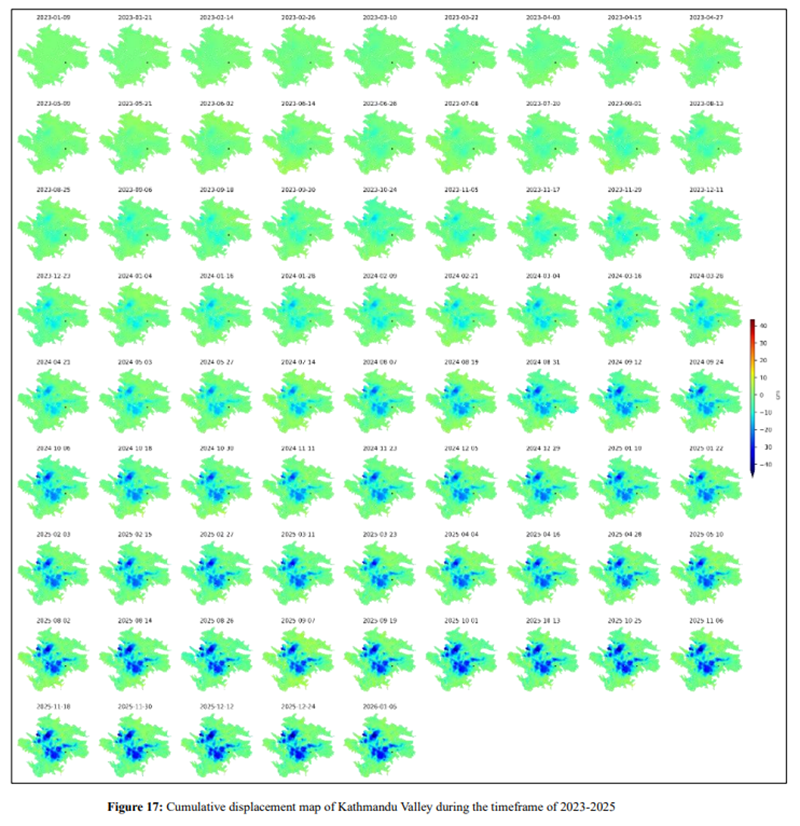
Valley conducted using InSAR technique from 2023 to 2025.
There are deep tube wells operating without registration in the Naxal area as well. However, Pravin Chandra, a hydrogeologist at the board, notes that they have been unable to identify all such deep tube wells across every location through monitoring. According to him, a year ago, the Police Headquarters in Naxal was also found to be operating a deep tube well without registration. Following notice from the board, the headquarters initiated the registration process in December 2025. It remains in process.
The board’s First Phase Licensing Report indicates that the deep tube well of Premier Insurance Company in Naxal is also currently undergoing the licensing process. Aside from this, data shows that 20 private-sector deep tube wells in the Naxal area are extracting water with valid permits. Board personnel state that additional monitoring and studies are required to ascertain the actual number of unauthorized deep borings.
Uncontrolled groundwater extraction and weak geological foundations are pointed to as the reasons why urban settlements in the central part of the valley appear as high-risk ‘hotspots’ for land subsidence. Not only the research by Rawal and Tamang, but other recent studies as well identify the indiscriminate exploitation of groundwater as a primary factor in the valley’s land subsidence problem.
Land subsidence caused by excessive groundwater extraction has been observed in other countries as well. International studies cite over-exploitation of groundwater as a leading cause of land subsidence. According to the scientific report Land Subsidence in the United States, published by the United States Geological Survey (USGS) in 1999, approximately 80% of land subsidence incidents in the United States are linked to the over-extraction of groundwater.
What is the way forward?
According to Ngamindra Dahal, hydrogeologist and Chairperson of the Nepal Water Conservation Foundation, it has been over a decade since the groundwater table in the valley began declining, giving rise to the problem of land subsidence. Yet, he states that it is paradoxical how entities indiscriminately extracting water face no disciplinary action despite such dire circumstances.
Hydrogeologist Ngamindra notes that government offices in the Kathmandu Valley began extracting fossil water as far back as the 1990s. “This refers to water located at depths of 200 to 300 meters underground that cannot be easily recharged by rainwater. Hundreds of deep borings are still operating today to pull up that very water,” he said. “At the very least, it is imperative to halt this unmonitored exploitation of water.”
Due to dense settlements and concrete infrastructure in the valley, the capacity for rainwater to seep into the ground has diminished. According to geologist Srikamal Dwivedi, the depletion of the water table is driven by the destruction of recharge zones in core urban areas, a lack of permeable surface structures and excessive groundwater extraction. “On the other hand, strategic efforts to harvest rainwater for reuse or artificial groundwater recharge remain inadequate,” he said.
Back in 2005, a study titled “Augmenting Groundwater in Kathmandu Valley: Challenges and Possibilities” by Ajaya Dixit and Madhukar Upadhya revealed that the valley’s core urban zones were the most vulnerable in terms of recharge capability. According to the study, out of the 114 square kilometers comprising the central region of the valley, recharge was viable in only a six-square-kilometer area around Godawari. Similarly, across the northern region around Bansbari, Dhobi Khola, Gokarna and Manohara, recharge was feasible in only 59 square kilometers out of 157 square kilometers, while in the southern region around Chobhar-Pharping, only 21 square kilometers out of 55 square kilometers allowed for water recharge.
Given that recharge areas are shrinking regardless, geologist Srikamal emphasizes that borings exploiting groundwater without authorization must be brought into the legal framework. He believes that the geo-environment of the Kathmandu Valley can be revitalized by prioritizing rainwater harvesting for reuse and subterranean recharge.
Srikamal points out that excessive groundwater extraction is occurring in areas where recharge zones have been destroyed and where structures to absorb water into the soil are nonexistent. He stresses that such over-extraction is being carried out by government departments themselves. “Here, the law applies to the powerless, while power centers and the government sector get a pass. How can we even discuss conserving resources under such conditions?” Srikamal said.
Indeed, government agencies themselves are operating deep borings in violation of the law and the board has failed to bring them to account. A clear case in point is the Department of Water Resources and Irrigation located at Jawalakhel in Lalitpur. There is a deep tube well on the very premises of the department, yet no permit has been obtained for it.
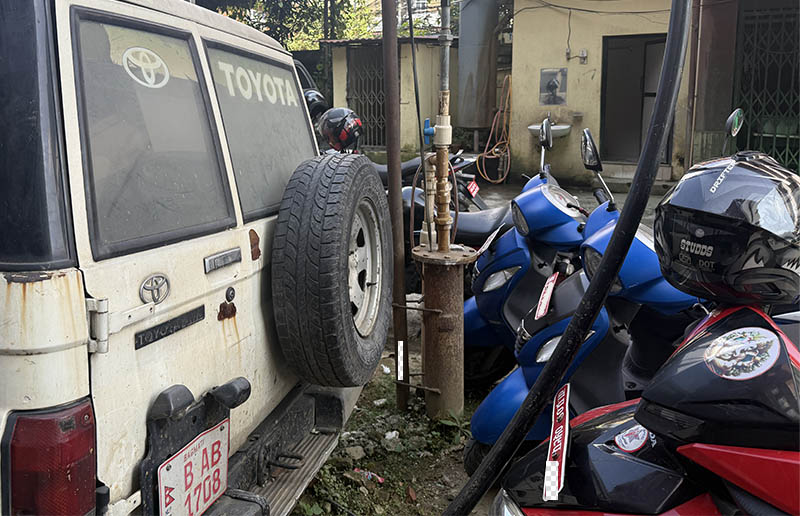
When initially asked about the lack of a permit, Deputy Director General of the Department, Kushang Sherpa, brushed it off by claiming that the boring machine was out of order. However, according to sanitation workers at the department, water is extracted from the boring every morning and evening.
When presented with this information during a follow-up, Kushang responded that it was not registered because it had been drilled before the legal requirement to obtain permits came into force. However, even for deep tube wells operating prior to the legislation, registration became mandatory once the board’s act was enacted in 2006.
Water resources expert Ngamindra Dahal states that there is no alternative but to bring all entities, both private and public, that are illegally extracting groundwater into the legal framework and regulate them. Along with this, he emphasizes the need to prioritize groundwater recharge to protect the Kathmandu Valley’s land resources. In his view, even those extracting water without permits and failing to pay revenues should be required to construct recharge structures.
Hydrogeologist Ngamindra notes that while KUKL (Kathmandu Upatyaka Khanepani Limited) extracts water in massive quantities, it has failed to do adequate work on groundwater recharge, such as rainwater harvesting, constructing wells and ponds, or measuring recharge levels. He asserts that if at least half of the extracted volume could be recharged, the pressure on underground water resources could be mitigated. “On one hand, population, infrastructure and development activities keep expanding while land resources face uncontrolled exploitation. On the other hand, if we do nothing ourselves, the valley will face dire crises in a few decades,” Ngamindra said. “The risk could escalate even further in the event of an earthquake.”
The board does not appear to take this matter seriously. Unable to curb the uncontrolled exploitation of groundwater, the board seems far from taking concrete steps toward recharge initiatives. Executive Director of the board, Dol Prasad, claims that studies regarding recharge have been conducted.
“Studies have been carried out and water security mapping has been done on where recharge is feasible and where it is not,” he said. “However, implementation based on those findings has yet to move forward. That will also happen.”
Cover Photo: A deep tube well operated without registration by the Harisiddhi Water Supply User Committee in Nagarjun, Kathmandu. Photo: Anita Bhetwal/NIMJN
In collaboration with Report for the World. Please adhere to our republishing policy if you'd like to republish this story. You can find the guidelines here.

Comments